At its best, Millennium was as good as anything else then on network television. At its worst, it was an embarrassing descent into paranoid community theater. Taken as a whole, while ahead of its time, it is hard to recommend today. This is especially true given modern sensibilities and the higher level of media literacy that now pervades popular culture. Despite this, I think Millennium is a much, much more interesting show to discuss than The X-Files, largely because of the dramatic arc of the show’s fortunes. This is not the story of a show with uneven writing that limped along for three seasons. This is a show that, in spite of itself, was three distinctively different shows, each iteration experimenting boldly with the formula of the last, often with calamitous consequences. It’s also a show that resonates uncomfortably with our present culture war, because it reflects a collection of latent paranoid strains of thought lurking at America’s fringes in th 1990s, inching closer to the levers of power. The show’s core demographic at time of broadcast were white male 18-to-35-year-olds who are now, 30 years later, an indispensable tentpole of a conspiratorial, reactionary right wing. Without intending to, Millennium gives us a narrow window into how they came to see the world in the way they now do.
While Chris Carter is credited with creating Millennium, his involvement in the show is generally overstated. He has at least co-writing credit for only 7 episodes, 4 of which appear in the first season. So what Carter really brings to Millennium is a compelling idea, embodied by a tone-setting pilot.
Like a lot of boomers growing up in California, Carter seems to have grown up with less of a concrete ideology and more of a collection of thematic preoccupations. His writing on The X-Files reveal that he belongs to what one might call America’s “conspiracy fandom.” We can easily imaging Carter pouring over a tattered copy of Chariots of the Gods? (1968) as a younger man, not so much believing its outlandish ideas about ancient aliens as merely thinking the ideas were really cool. We may assume he called a toll-free number to receive, monthly, each new volume in an eventually complete collection of Mysteries of the Unknown (1987-1991) that sat within arm’s reach while brainstorming story ideas. The X-Files is probably best understood as high budget fan-fiction set in this world of paranormal memes, starring Gillian Anderson as a serial-number-filed-off Clarise Starling (Silence of the Lambs, 1991) and David Duchovny as a store-brand Jim Garrison (JFK, 1991). Carter recognized earlier than most television screenwriters what an enormous appetite there was for conspiracy theories, and he elevated writers who could expertly sanitize America’s fringe subcultures of their most objectionable ideas so they could be repackaged for mainstream audiences.
This is perhaps unfair to The X-Files, or at least betrays my own opinion that I don’t think it’s nearly as good as people remember. However, the credit that Carter absolutely deserves is for his cultivation of a writing style that flatters his lead actors. Even though The X-Files was largely unserialized (as was almost all television made at the time), having leads who you want to see reacting to problems is the way to make viewers intensely loyal. Audiences loved Mulder & Scully. So when he was tasked with producing a second show for Fox, Carter understood that his new protagonist would need to have the same sticky magnetism and staying power. As he wrote the spec script for Millennium‘s pilot, he had one actor in mind: Lance Henrikson.
If you have watched more than a handful of episodes of Millennium, being a fan of Lance Henrikson is probably a big part of why you keep tuning in. He belongs to a particular class of rock-solid characters actors who immediately elevate the material with which they are associated through their signature style, even when the writing itself is not strong. Other actors who spring to mind are Jeffrey Combs, Parker Posey, Dominique Pinon, and CCH Pounder: When one of these actors appears on the cast list, you have a pretty good idea of the sort of performance you’re going to get; if you’re a fan of that performance, you’re not going to come away disappointed in their contribution.
The first impression Henrikson makes is with his craggy, weathered face; the second is with his deep rumbling voice. He looks and sounds like someone who ran away from home at the age of 12 to ride the rails, tricked the US Navy into letting him enlist at age 15, and travelled the world, but didn’t learn to read until he was 30. This is because Henrikson ran away from home at the age of 12 to ride the rails, tricked the US Navy into letting him enlist at age 15, and travelled the world, but didn’t learn to read until he was 30. His first acting gig came about because he had built the sets for a theatrical production, and he learned to read in order to read acting parts. As an early stopgap, he recruited friends to help him record scripts on tape, so he could commit entire scripts, for every character, to memory. Henrikson’s life has been hard in very specific kind of way that is increasingly difficult to imagine in 21st-century America.
This lived experience informs and permeates Henrikson’s performances, and is especially important to his depiction of Frank Black, Millennium‘s protagonist. Like Henrikson, Frank Black is a patient, nonjudgmental person whose empathy is a source of strength and competence. Like Henrikson (we may presume), Frank Black has borne witness to humanity’s capacity for cruelty and has been in dangerous situations, in a way that has made him reserved and thoughtful. In short, Henrikson effortlessly brings both authenticity and maturity to a genre in which protagonists are often instead portrayed as half-mad and risk-seeking. Frank Black is not a boundary-walker who struggles with evil’s seductive allure. He is not a petulant rebel who resents the authority with which he has been endowed. He is a man who has seen humanity’s darkest excesses and has glimpsed a darker evil beyond humanity’s ken, and who simply isn’t impressed.
At the same time, an absolutely critical quality that Henrikson brings to the performance is a prosocial warmth. His chemistry with Megan Gallagher (portraying Frank’s wife Catherine) and Brittany Tiplady (portraying Frank’s young daughter Jordan) feels sincere and familial. While Millennium‘s stories are often dark to the point of bleakness, especially by the standards of 90s network television, Henrikson is given opportunities in almost every episode of the first season to smile, to give and receive comfort, and to have a life outside of his job. Contrast this with the very much all-business portrayal of Mulder & Scully, and it becomes obvious why Millennium often feels like it has higher stakes: It’s clear not only what Frank Black is fighting for, but also that he remains emotionally connected to those stakes. None of this works if the audience doesn’t buy Henrikson’s portrayal of a man who is an earnest participant in what’s good in the world, and that he fights the darkness precisely to protect that goodness.
Flatly, Henrikson carries the show. He’s not merely the star, he’s the axis around which the show turns. While most crime-oriented shows create a stable of supporting investigators who provide scaffolding, Millennium regularly drops Frank into new cities with new investigators, especially early on. As such, audiences hitch their wagons, or don’t, to the character of Frank Black above anything else the show has to offer. This wagon, unfortunately, has a hard road ahead.
The practice of criminal profiling, as initially practiced by the FBI’s “Behavioral Science Unit” in the 1970s, quickly became a topic of national interest during a decade seemingly overflowing with serial killers. Sensational journalism fueled widespread paranoia and dread surrounding the Manson Family cult, the Summer of Sam, and the Night Stalker. Perhaps no serial killer became more synonymous with calculating, Luciferian evil than Ted Bundy, and a growing right-wing obsession with a perceived erosion of civil society misunderstood these men as supervillains. There must be, many felt, a kind of superhero who is the mirror image to these bad seeds, and crime fiction seized on profiling as the mechanism for such superpowers. To ensure that good would triumph over evil, criminal profiling geniuses began popping up in fiction, Batman-like heroes who were the only ones who could stop these serial killers.
Red Dragon (Thomas Harris, 1981) provides the archetypal “profiler protagonist” in Will Graham, a character whose insight into and empathy for the serial killer mind is so intense that it seems to border on psychic. This idea that profiling lets an agent “see through a killer’s eyes” spread quickly in the genre, as did the idea that profilers are somehow “too close” to the darkness and are at risk of being corrupted by it. This has led to two broad styles of profiler protagonists: No-nonsense FBI robots who you would not want to invite to a party (e.g., most of the cast of Criminal Minds) or fragile, damaged head cases who are being destroyed by their talent (e.g., Wire In The Blood‘s Tony Hill, or Graham himself).
Since Carter is a writer who borrows and riffs, Frank Black is almost certainly first imagined as yet another riff on Graham, a profiler whose “visions” let him “see what the killer sees” in a way that lets him solve otherwise baffling cases involving uniquely disturbed and evil killers. However, we can see immediately in Millennium‘s pilot episode that Carter has resolved to go to a different well for this new show. You see, The X-Files is a show squarely on the science fiction side of the speculative fiction spectrum, making it “off-brand” to take a crack at many of the conspiratorial rumblings that permeated America’s fringes in the 90s. This mostly limited The X-Files to what we might call the “secular occult” - aliens, cryptids, monsters, C.H.U.D.s, psychic phenomena, and government coverups. There was, however, an entire other universe within America’s obsession with occult that was overtly spiritual and supernatural. These included whispers of Satanic cults able to do ‘real’ magic, angels and demons hidden among us, the prophesies of Nostradamus, and whole cosmologies built around esoteric misreadings of the Bible. Much of these preoccupations were, well, millennial. Carter, we may assume, was just as much a fan of these flavors of fringe weirdness as he was of the more secular variety, and in Frank Black had a new potential jackpot: A profiler whose “gift” is not merely forensic science, but actual prophecy.
Framing Frank Black as a prophet who struggles with his visions works remarkably well as a storytelling engine. On the one hand, the show is initially very cagey about whether Frank’s abilities are supernatural or not, and this greatly enhances the early episodes in a way that would later be perfected in season one of True Detective. On the other hand, this takes the limiters off: It’s entirely OK for Frank’s visions to let him make impossible leaps, and this gives the show license to simply skip most of the investigating. Once we know the show’s rhythm, we begin each episode knowing that Frank will zero in on the killer with unreasonable rapidity, almost as if he’s falling into evil’s gravity well. While it’s true that perp-of-the-week cop shows tend to be depressingly predictable (our hero gets their perp in 45 minutes, or your money back!), Frank Black’s cheat codes give the show a completely different energy. They feel funereal and contemplative. Each episode seems to be asking not “Will they get the bad guy?” but instead, “What does any of this mean?”
One of the main ways Millennium does this is to spend an unusual amount of time showing us the lives and preoccupations of its killers, who provide most of the conflict in the first season. This is way ahead of its time, and only works because the cop side of the show is being speedrun by its protagonist. We see first-hand that killers in the show are brutal, vicious, and cunning, but also pathetic, insecure, and self-destructive. As television monsters, they’re unusually human, and because we the audience are granted insight into their sad little lives, many episodes end with the unusual feeling that only we and Frank Black really understand how it all came to this, as the rest of the cast struggle to make sense of any of it. Put another way, the show makes the audience feel like an insider, like they know something known only to a select few, almost like they are members of a secret society.
This brings us to Millennium’s other major tent pole: the Millennium Group. Frank Black, like all good profiler protagonists, retired from the FBI because the job was too much, only to be brought back to crime fighting. In this case, we are introduced to him as a freelancer who works with a forensic consulting group that assists law enforcement. Throughout season one, there are hints that the Millennium Group’s secretive behavior and unusual resources might have sinister implications, but it’s just as clear that their motley roster of specialists are law enforcement’s only hope in the face of otherwise inscrutable crimes. Frank is new to the Group, and it seems clear that Carter envisioned it as a storytelling engine meant to operate in similar ways to the central “shadow government” conspiracy in X-Files lore. This enticing promise (“Stay tuned to find out what are the Millennium Group are all about!”) will ultimately be the show’s downfall, but its role in the first season is mostly an easy way to justify Frank Black being airdropped into America’s Weirdest Cases all around the country despite no longer being an agent of the law himself. Indeed, a lot of cop show tropes disappear because Frank is outside the chain of command entirely, allowing the writers even more creative freedom.
So we now have all the pieces in place: Millennium is a show about a battle between good and evil during what feels like the End Times, and as such is shot through with themes that are too moralistic, too spiritual, and often too overtly Christian to fit into Carter’s main franchise. Its hero is a reserved but kindly patriarch, old and wise, gifted with powers of prophesy that serve less to bring about justice than they do to bring about judgment. It is a world of many figurative and a handful of real demons, gnawing at the roots of civilized life, and even when their campaigns of terror are brought to an end, we are invited not to rejoice, but to reflect and sometimes even mourn. In other words, it’s a show with powerful and compelling vibes, and also exactly the show someone would watch devotedly 20 years before becoming obsessed with QAnon.
The first season of Millennium opens with a lavishly produced pilot that sets the aesthetic and thematic sensibilities for the season. The mood is one of lamentation and quiet expectation, not tension and conflict. Visually, the show feels like a big step toward television that “looks like a film” relative to other shows airing at the time. In particular, the cinematic style of David Fincher’s Se7en (1995) seems to have been a major influence; given its surprise success at the box office the year before, Fox was likely persuaded that there was an untapped market for grimly violent religious esoterica. It’s easy to forget how cheap most television in the 90s looks to modern eyes (it was never meant to be seen at 1080p, after all), and although it’s still a product of its time, Millennium‘s emphasis on the ways in which it was shot, produced, and scored feels surprisingly modern. This was a risk: While Carter lavished attention on the pilot and devoted a full month to its production, mainline production would advance much more rapidly. According to Henrikson, all of his footage for a particular mid-season episode needed to get shot in about eight days, and he would then be on to the next episode.
Part of the reason Millennium opens strong is that it establishes its characters and their interactions within narrow contexts. Frank’s family unit is archetypal and uncomplicated, and the show encourages us to take the warmth between the actors at face value. Frank’s coworkers are similarly familiar. In detective Bob Bletcher (Bill Smitrovich) we immediately recognize the exhausted competence of a Commissioner Gordon; in his subordinate, detective Bob Geibelhouse (Stephen Lang) we immediately recognize the show’s resident knucklehead. The only supporting role that doesn’t feel like it was stamped out at the factory is that of Peter Watts, memorably performed by Terry O’Quinn. Watts represents the mysterious Millennium Group, and comes across as a meticulous egghead who has mastered various forensic sciences. On paper, Watts has the potential to be a very tedious character; during the first season, he mostly serves as a vehicle for exposition, whether it be to explain details of the crime, or drop clues about the Group and its operations, or just to give Frank the opportunity to verbalize what he thinks his visions/intuitions mean. The secret to O’Quinn’s performance is to convey every one of these details like it’s a strictly need-to-know, hush-hush, another brick in a wall that separates the war from the civilian population. Millennium is, at its heart, a fundamentally conspiratorial show, and Peter Watts feels like Frank Black’s closest and most connected co-conspirator.
As the show progresses, the most striking thing about it is that it is simultaneously a show with very conservative politics but also with a broadly appealing humanist message. I see this less as a contradiction and more as a sales pitch. Like a lot of conservative media, Millennium does not want to admit to itself that it is conservative, or that its conservatism has unanticipated costs and consequences. Frank is sold to us as a “lapsed Catholic” who simply has “strong values” and “knows right from wrong.” His empathy, his warmth, and his grit are all saintly qualities, “better than real.” What keeps him from being boring as a character is that Henrikson’s performance makes all those qualities feel earned. In the world of the show, it feels like maybe the world is ending, but also that maybe patriarchs like Frank Black can make everything alright.
Pulling back, it’s easy to see that the groups for whom this chord will resonate with most are the evangelical right. It’s important to remember that at the same time Millennium is on the air, Newt Gingrich is speaker of the house, and a coalition of knee-jerk reactionaries are being built into what will eventually become a robust and durable American fascism. The Left Behind novel series (1995-2007) is underway, and Bibleman (1995-2010) is being sold direct-to-video to parents who won’t let their kids watch broadcast TV. Millennium‘s premier comes mere weeks after the launch of Fox News. As of 1996, the media establishment still does not take this segment of the population seriously, and has only recently begun to pander to them in careful steps. Millennium is not an honest portrait of such viewers; it is instead the most flattering possible image they could have of themselves. Frank Black is the archetypal Silent Generation conservative in a mirror, brightly. He has all the patience, humility, and good judgment that the practiced hypocrites of the late 20th century claimed to have. If you’re a young adult man from a conservative background in 1996, he’s probably the dad you wish you had.
By all accounts, Carter was supposed to hand Millennium off to another showrunner after making the pilot, but whoever Fox had arranged to take the job dropped out almost immediately, and Carter was suddenly in charge of running a brand new show in parallel with the fourth season of The X-Files. Carter chose to keep his focus on his much more popular established show, and this created a very peculiar absentee showrunner situation for the rest of staff. Writers for the show, for example, were given only mild guidance and were expected to write entire episodes more or less alone before Carter and a few junior writers would make a few tweaks. Across the season’s 22 episodes, the show credits 11 directors and 14 writers.
Carter had already implied that he imagined later seasons of the show would reveal “important secrets” about Frank’s powers and the Millennium Group’s real agenda, and this set the parameters for the writers: Don’t rock the boat when it comes to character and lore, but otherwise think outside the box. So, with different writers pulling in different directions, Frank mostly remains grounded in the characterization established in the pilot, but is faced with a surprising variety of cases that take him all over the country. This is crucial: When tuning in the next episode, you really don’t know what you’re going to get. Aside from Catherine Black (who appears in every episode of the season), none of the other supporting cast are regulars. Peter Watts only appears in 13 of 22 episodes; Bob Bletcher only appears in 11; Geibelhouse only appears in 8. This makes sense once we consider how perfunctory “investigation” becomes when your protagonist has cheat codes: It’s not really a show about solving crimes, so the supporting cast has a lot less to do.
Instead, we see the first season ruminating (sometimes reflectively, and sometimes dysfunctionally) on the ‘nature of evil.’ The only easy answer the show is interested in giving is that “evil exists” - everything else is presented as complicated. The four episodes written by Carter profile dramatically different flavors of evil: serial killing, cult indoctrination, family sexual abuse, and a literal demon. Pull Frank Black out of the frame and change the musical scores, and these four episodes feel like four different shows. What holds it all together is Henrikson’s bedrock-solid performance as Frank, which keeps the show on rails even during some of the season’s riskier experiments.
Aside from Carter’s contributions, several other writers deserve mention. Two of these are Glen Morgan and James Wong, who had by 1996 been reliable creative partners to Carter, writing many episodes for The X-Files. The three episodes they penned for the first season of Millennium are particularly strong. While all three are serial killer episodes, each has a distinct and interesting premise, and the episodes share a more energized pace that is a bit more slick and commercial. It seems the suits upstairs take note of this, because they will allow this duo to take over running the show in season two.
The other important screenwriter to keep an eye on is Chip Johannessen, who is promoted to a producing role midseason in addition to writing. He writes or co-writes four episodes in this window of time, and they are easily the least coherent and most conspiratorial episodes of the season. These include such eyebrow-raising propositions as, “What if Chernobyl was an inside job?” and “What if science proves a coming planetary alignment will end civilization as we know it?” and “What if the Antichrist is alive and waking among us, but also is literally Boris The Blade, a character in a movie that doesn’t exist yet?” and “What if we use a single episode to recap the entire multiseason plot of Orphan Black, a show that also doesn’t exist yet?” These episodes are not necessarily bad (one includes a blessedly deranged performance by Brad Dourif as a conspiracy loon), but they operate on pure vibes. Don’t think too carefully about the events they depict: If you treat them as anything other than prime time drama slam poetry, they’ll fall apart under the scrutiny. These episodes also make what is, in my opinion, a crucial error: They give Frank Black a temper that he simply doesn’t have in other episodes. This does not augur well, because Johannessen will effectively become the de facto showrunner in season three.
By the end of season one, Carter was ready to turn his full-time attention back to The X-Files. Having received the go-ahead to begin preproduction on an X-Files film that would ultimately release in 1998, Carter was all too happy to hand Millennium off. Even so, his successors were chosen by Fox, and it’s unclear how fully Glen Morgan and James Wong had Carter’s blessing when they took the reigns.
Morgan & Wong had a track record of success writing for The X-Files, but had greater ambitions. In 1995, they got their chance and created a show for Fox called Space: Above And Beyond, whose genre could succinctly be described as “space marines!” Slightly more verbose descriptions we might give today include “What if Starship Troopers (1997) but completely sincere?” and “What if Aliens (1986) but very little happens?” While the show never found its audience and didn’t set the world on fire, it wasn’t bad by 90s standards, just dull. Looking back now, it’s easy to see how it aspired to a gritty, grounded hard sci-fi aesthetic that would later be integral to shows like Battlestar Galactica (2003-2009) and The Expanse (2015-2022). What was clear even then, however, was that SAaB was decidedly more conservative than its competing space shows, Star Trek: Deep Space Nine (1993-1999) and Babylon 5 (1993-1998). This overt appeal to a conservative audience, as much as Morgan & Wong’s successes as X-Files writers, probably made Fox feel they were right for the job.
Under this new supervision, Millennium immediately took a different turn. By the end of the season premiere, our end-times dad Frank Black has murdered a perp in anger (with cause!) and has blown up his family in the process. One episode later, he has saved a small town from hellhounds by burning down a carpetbagging liberal’s house. The prior season’s vague, theme-based worldbuilding, which had only tipped slightly into the overtly supernatural, now openly embraced Frank’s gift as a sort of prophetic magic within a much more overtly Christian cosmology. The hazy nuance is dialed back. The pacing is more brisk, the tone less grim, and the production more polished. And the writing gets much, much more conspiratorial. What season two expertly anticipates is the same mainstreaming of Christian conspiracy culture that will rocket Dan Brown to authorial superstardom over the following decade.
In order to accomplish this, the show pivots away from broad allegories of war in the shadows between Good vs. Evil and toward concrete worldbuilding that positions the Millennium Group as the literal Illuminati. We can paint by numbers to anticipate some of the resulting character conflicts. (How much should Frank trust the Group and its members? What secrets will be revealed if he rises in their ranks, and will the price he needs to pay be worth it?) New recurring characters are introduced to give the Millennium Group a clearer hierarchy. Of these, the only character who deserves a mention is Lara Means, played by Kristen Cloke (who just so happens to be a former cast member of SAaB and also just so happens to be Glen Morgan’s wife). Lara is a clinical psychologist, a no-nonsense tough-love shit-kicker to play foil to Black’s unflappable wisdom, and a middle-aged conservative’s idea of a tastefully hot female guest star. She also has visions of a much less ambiguous variety than Frank’s: She sees literal angels, which the show assures us has powerful significance but which almost never seems to crack cases the way Frank’s crime-o-vision has in the past.
The new dynamics give the show new opportunties to surprise the viewer. Some episodes appear to be a killer-of-the-week story but morph into peeling back layers of the conspiracy. Others never introduce a criminal element at all, revolving entirely around personal and family conflicts. Despite this, season two feels coherent and cohesive - the showrunners being present and invested in the show makes an appreciable difference. In particular, a (mostly Platonic) triangle of motivations forms between Frank, Lara, and Peter Watts that fits nicely into the spaces between episode storylines. Watts, we come to understand, is a man of radical Christian faith who belongs to the Millennium Group’s evangelical branch. He trusts Frank’s skills and temperament but not his religious ambivalence; he sees potential in Lara’s religious visions but considers her a rookie, not ready for the big leagues. Frank, for his part, has found his relationship with Watts complicated by the Group’s power struggles and finds in Lara a sympathetic figure who is able to relate to the burdensome aspects of having a prophetic gift. And Lara is torn about whether to side with those in the Group who believe she has a divine gift or to follow Frank’s more skeptical lead. While these undertones evolve as B-plot to each episode’s A-plot, they are welcome undertones.
The A-plots, however, are a very mixed bag. Where season one occasionally tipped its hand as catering to more conservative sensibilities, season two panders in ways that can be very uncomfortable to watch. Two of the episodes in particular (“A Single Blade of Grass” and “Siren”) feel shockingly racist; a third (“Sense and Antisense”) manages to distract from how racist it is by being almost incoherently bizarre (unsurprising on both counts when we learn that it’s another Chip Johanessen joint). The worst episodes of season two are a mile worse than the worst episodes in season one.
The show also substantially muddies the B-plots pertaining to Frank’s family. Now amicably(?) separated from his wife and daughter, the show drops any pretense that they represent the goodness in the world that is worth protecting. In one sense, that’s an upgrade - there is an opportunity to promote Frank’s family to a status higher than “aspirational Best Dad trophy,” but Morgan & Wong don’t seem to know what to do with those characters and mostly squander that opportunity. When a show disappears into the lore of its own conspiracies, the “civilians” on the outside of that conflict have few options but to be confused and frustrated pawns. This is what the season settles on, eventually with dire consequences. This also robs Henrikson of opportunities to remind us of Frank’s fundamental warmth.
However, season two also contains some of the show’s best episodes. Three episodes stand out. “The Mikado” is the season’s one genuinely original-feeling serial killer episode, executing on an “Internet murderer” premise that was way ahead of its time in 1998 and today would feel right at home in a season of Black Mirror. “Jose Chung’s Doomsday Defense“ is one of two cases in this season in which writer-director Darin Morgan (brother of showrunner Glen Morgan; way to keep it in the family, Glen) is allowed to play an elaborate prank on the audience by having the show parody itself (a trick D. Morgan had previously played on The X-Files using the same titular character). In addition to being surprisingly funny, this episode is also notable for being an early and scathing critique of Scientology a full nine years before South Park would take its swing.
The most interesting episode of the season, “The Curse of Frank Black,” is a classic ghost story set on a Halloween night. The episode unfolds slowly, patiently, and with long stretches of minimal dialogue. The audience, expecting some sort of crime or inciting incident, doesn’t get one; instead, a string of coincidences and mild annoyances cumulate into a feeling of whispered dread. Gradually, the episode reveals itself to be a sort of Hell House vignette, camouflaged as prime-time TV. On the one hand, it’s a bold and experimental break from formula; on the other, it’s the most explicit the show has been willing to get to this point about not merely being supernatural, but Christian in its cosmology. It’s an unambiguous flag planted in the ground that affirms where the show stands in its second season, a considerable distance from its starting point in season one.
As much as season two works, its aggressive lean into an increasingly mainstream culture of Christian conspiracy theories should give us considerable pause. While the canonical superfice of its conspiracies are presented as original fictions (no resemblance to persons living or dead, yadda yadda), their underlying form is old, familiar, and dangerous. The season comes within a hair’s breadth of declaring that the Millennium Group is an ancient and secret conspiracy that includes both heterodox Christian sects (who, today, happen to feel just like American evangelicals) and Jews. The latter is strictly implied, never stated outright, but we can infer this from two factors. First, the internal politics of the Group are framed as “believers” vs. “secularists,” with the former unambiguously framed as Christian dominionists and latter being characterized as international, highly educated, and largely amoral. Second, we learn that the Millennium Group is explicitly waging an ongoing war with a cabal of Nazi wizards who scattered themselves around the world after WWII. So, as the season progresses and the “true” motivations of the Millennium Group are implied to be dark and dangerous, how exactly is the audience meant to reconcile them as master manipulators on the global stage who are also fervently anti-Nazi?
The answer isn’t complicated: Millennium‘s second season has taken a crude plaster cast of Christian conspiracies form the mid-90s, rotten to the core with racism and antisemitism and very cozy with skinheads and Clinton-era militiamen. Once the copy has been pulled out of the mould, everything is shot through a Barbara Walters soft focus lens for the sake of plausible deniability. It’s taken a hateful worldview full of incoherent reactionary anxiety and sanitized it in a strong bath of Prime Time TV Standards & Practices. This is the ugly truth of shows like Millennium, as entertaining as they sometimes are, as much as we enjoy the personas of its principal cast. Season two is Baby’s First Globalist Conspiracy. Through talk radio, chain emails, and barbecue meetups that serve as low-key Klan recruiting drives, fans of The X-Files and Millennium and later The DaVinci Code will be told how to decode the “hidden truths” in these works. In this way, season two provides a window into the very early stages of a radicalization funnel that today’s Republican party has been flowing through since the end of the Cold War.
In fairness, I don’t think Morgan & Wong are themselves full-throated fascists. From their body of work, I’d peg them as incurious conservatives. I’m inclined to think that they, like many 90s conservatives, saw the kooky conspiracy theories at the fringes of their communities as harmless fun, fodder for popcorn entertainment just like the flying saucers and duct-crawling monster men of The X-Files. But this casual commodification of conspiratorial thinking has always had the risk of spiraling out of control. Who knows what sort of cultural force Millennium would have become if Fox had kept Morgan and Wong on for five or six seasons? While there’s zero chance that it would have ever become the kind of cultural juggernaut that The X-Files remains even today, I think it could plausibly have become a pillar of dominionist indoctrination alongside The Passion of the Christ (2004) and the Left Behind books.
Instead, Millennium‘s ratings steadily (if gradually) declined to around 5 million US viewers an episode. The numbers weren’t abysmal - Deep Space Nine already had a slightly smaller audience at that time, while Babylon 5‘s audience was substantially smaller. Still, Fox wanted X-Files numbers and we now know with hindsight that no new show was going to get X-Files numbers ever again. Furthermore, Carter was reportedly unhappy with the direction of the show. With the end of production looming for season two, the writing was on the wall: Morgan & Wong were not getting contract renewals, and the show was possibly going to be canceled altogether.
So, in a rather baffling fit of pique, Morgan & Wong did the unthinkable. In the last two episodes of season two, they ended the world.
We may conclude from a number of context clues that Chris Carter was displeased with the show he returned to as showrunner in the summer of 1998. Frank’s family isn’t merely broken, but shattered by the self-sacrificing death of his wife Catherine in the final moments of season two. The Millennium Group had dropped its mask and the audience may presume they are some flavor of baddies from here on out. Any long-term plans Carter may have had to slowly unfurl the Group’s machinations or explore Frank’s family life have become moot. But maybe none of that matters anyway, because season two’s ending implies that most of the rest of the world has also died, thanks to a pandemic seemingly brought about by the Millennium Group as part of an elaborate vaccine conspiracy (all harmless fun, surely, to make that your season finale). It feels very much like Morgan & Wong decided that if they couldn’t play with Frank Black, nobody could, and torched the place as they left in the name of giving their audience a spectacle. Their reconciliation with Carter was probably a slow process: They do not return to collaborate with Carter on anything X-Files-related until the show’s 2016 revival.
Step one is for Carter to heavily retcon the ending: No, the world was not destroyed in a pandemic. (That was a hallucination!) Instead, the effects of the virus were limited to the Pacific Northwest, with perhaps only a few dozen victims. Step two: Frank Black is now once again at the FBI, with every cliché that entails. His unflappable demeanor is now in a state of permanent flap: He’s furious that the Millennium Group killed his wife (and presumably several dozen others) and nearly killed his daughter; understandably, he is also flummoxed that no one takes his accusations seriously. Aside from various tense exchanges with Peter Watts (who has fully embraced the heel turn that has been asked of him), Frank’s main punching bag is his long-suffering boss Andy McClaren, played by Stephen E. Miller. McClaren can’t afford to lose Frank’s talents but can’t seem to keep him on a short enough leash either. Which brings us to step three: Hoping to cool Frank down (or at least keep tabs on him), McClaren partners Frank with Emma Hollis, played by Klea Scott. Hollis is a newly promoted special agent, untested and idealistic, who knows Frank by reputation for his profiling talents and then struggles to work with the raving loon he has become. Both quickly realize that they’re guided by common values, and the show follows a mostly procedural formula that can be summarized as “What if Mulder was older and crazier, while Scully was more inexperienced and black?”
Purely on the basis of their performances, Henrikson and Scott have good chemistry. They sell Frank and Hollis as an odd couple who figure out their common ground and cultivate trust. A few fans still insist that Klea Scott “ruined Millennium,” but that’s not true and probably more than a little racist. She and Henrikson were doing the best they could with the scripts they were given. And boy howdy, are those scripts awful.
Carter rapidly reverted to an absentee status - the decision by Fox executives to renew Millennium caught everyone by surprise, and Carter remained much more interested in tending to his firstborn franchise, same as he ever was. So in practice, the ship from here on out gets helmed by Chip Johannessen and his first mate Michael Duggan. While Carter will swoop in a few times with scripts that harken back to some of his season one ideas, season three is mostly dominated by the formless, angry incoherence of Johannessen-style conspiracy. Gone are the slick repackagings of season two that trick you into feeling both smart for getting the reference and safe for seeing it all has harmless fun. Long gone is the somber, nuanced sadness of season one. It’s Pepe Silvia yarn wall time, baby, and before we’re done, we’ll reveal that the real reason the Millennium Group went bad was because of J. Edgar Hoover! Buckle up for the revelation, because it’s not the hip new theories of Christian fascists that lie at the heart of the world; it’s the older, duller Cold War paranoia in those yellowing paperbacks your belligerent uncle keeps telling you that you need to read. Given a second lease on life, Millennium fizzled out because it tried to trade in its audience of 30-somethings for an audience of 50-somethings, and with anemic ratings, ended up getting canceled instead.
When Millennium was good, it was great; when it was bad, is was cadaverous marionette of its best self. At all times, it was reflective of a reorganization by 90s media around a new set of political identities. Rewatching it now will be nostalgic for some, claws-on-a-chalkboard for others. Like I said at the outset, it’s hard to recommend.
I still stand by my position that it is a more interesting show than The X-Files, and that we can learn quite a bit more from its failures than we can from its older cousin’s success. We can learn an important lesson, I think, in the gulf between what Millennium‘s paranoia story was about and what its performances conveyed. As much as the show disappeared into its own conspiratorial vortex, Frank Black remains a compelling role model in many respects for most of the show. As I reflect on modern “prestige television,” I’m struck by how rarely I feel like a character is “better” than the show they’re a part of. The opposite formula seems like it’s easier to pull off: Many objectively great modern shows give us tragic and irredeemable scumbags (your Walters White and Tonys Soprano) at the center of their timeless productions. Prestige television doesn’t need to be all antiheroes.
The bottom of it all for me, though, is what it means to push past nostalgia and face history. The late 90s have been an object of fascination for a while now, and as much as fashion ebbs and flows, time periods that have passed through that fascination lens tend to become strange caricatures of themselves. It’s easy now, I think, for people to think of the late 90s and remember Daria, and Deep Space Nine, and Frasier. People are still rewatching The X-Files and Friends. It’s harder to remember that era’s more conservative elements, the mood and themes that dominated half of the country’s culture. It’s unflattering to reflect on how rudderless and hair-trigger conservatives seemed after the Cold War ended but before 9/11 once again made it cool to hate foreigners. It’s unnerving to confront how morbidly eager many were for apocalypse, and how incoherent they were in their hatred of a majority of their fellow citizens. When asked today, many won’t answer honestly about the way they comported themselves in those days; indeed, many can’t, having sold themselves a different story.
So there is value in reminding ourselves of the bad behaviors of the past, and also in reminding ourselves of the stories people have told themselves about themselves. Millennium describes a bleak world full of violence that can neither be prevented nor predicted. It’s a doomed world, running down the clock of its 4th quater. It’s a fantasy world, despite Chris Carter himself describing it as “more real” than the world of The X-Files. But it’s a world many people in its audience would rather have lived in than the one they had. It is a world of slim hope for only the ‘right’ people and none for the rest. We would be wise to disagree with such visions instead of ignoring them. Because those visions, those big-yellow-house-for-me-but-not-for-thee aspirations, endure and animate our politics, and we ignore those forces at our peril.
]]>As I’ve noted before, every season of the show thus far embraces the sensibilities of a different genre of fiction. The overarching theme of Season Three is true crime. You might object that true crime is a non-fiction genre, and thus not an appropriate label for a television drama, but I contend that the fictive, fictionalizing qualities of true crime are at the heart of what this season is doing.
After a tepid response from critics, backlash from fans, and subsequent disappearance into the Streaming Era’s rapidly expanding memory hole, showrunner Nic Pizzolatto and the HBO studio execs appear to have conceded that perhaps a season a year wasn’t going to be possible without cutting a lot of corners. They weren’t alone in this feeling, and we have since seen fewer and fewer prestige dramas released on yearly cycles. In the last decade, seasons of scripted, serialized dramatic television have had shorter overall runtimes and longer gaps between seasons, for a variety of reasons. Famously, it’s not always worth the wait, but as the distinctions between television production and film production have continued to blur (whether it be in terms of the writing process, the cost, or the complexity of VFX and post-production), a kind of quality-over-quantity sensibility has overtaken the industry.
In the four years between seasons, Pizzolatto appears to have sought a middle ground: Although still doing most of the writing, he credits a few coauthors with assisting on specific episodes. Filming did not begin until February of 2018. The visual cohesion of the season is better maintained by limiting the directing team to just three: Jeremy Saulnier, David Sackheim , and Pizzolatto himself. Saulnier evidently left after only a couple months, and given the non-linear structure of the show, it’s unclear who directed which scenes, but given the non-linear storytelling of the season, I’d be willing to bet that the show was shot chronologically with scenes re-ordered during post-production. This would make 1980 a Saulnier/Pizzolatto joint, whereas 2015 would be a Sackheim/Pizzolatto joint, with the 1990 era acting as a bridge.
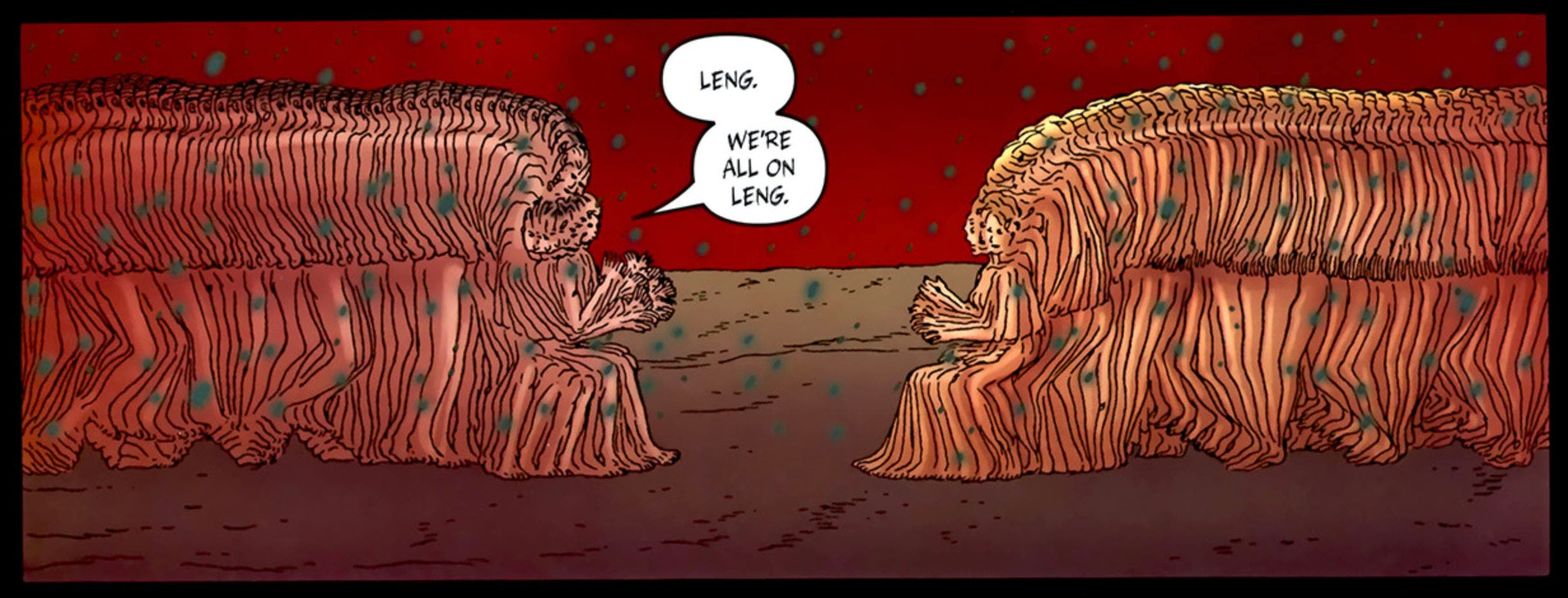
A viewer’s first impression is that Season Three (hereafter, TDs3) plays it safe to a fault in its desire to recapture the success of Season One. This isn’t entirely baseless, as many of Season One’s distinctive features are evident from the first moments of the show. The season premiere centers an odd-couple pairing of detectives with complementary skills. The story is set in the American South, and immediately evokes the economic, class, and racial inequalities of the region. The story is once again non-chronological, with an “interview” conceit that naturalistically compels characters to provide exposition and give opinions they would be less likely to say aloud in normal dialogue. There are even hints toward the show’s earlier forays into mythos fiction (most obviously, an Advanced Dungeons & Dragons module with slightly anachronistic graphic design entitled “The Forests of Leng”). The messaging of the premiere seems obvious: “True Detective has gone back to its roots, tell your friends.”
It’s important to recognize that Pizzolatto’s chief quality as a writer is that he wears his influences, if not on his sleeve, then at least only half concealed as a cheeky pocket square. The first two seasons were filled with references to media that Pizzolatto has enjoyed, and he seems to relish including coded references. Not only that, but he also riffs and elaborates on existing works and tropes. It’s not hard to see the influence of popular works of true crime nonfiction, such as In Cold Blood (1966), Midnight in the Garden of Good and Evil (1994), and The Innocent Man (2006). That said, a substantial part of what makes TDs3 remarkable is its fairly obvious riffing on Season One. Not a remake or a rehash, TDs3 is a fundamental reworking in which the engine is torn down to its components and rebuilt into something else. He knows this music; let’s change the beat.
Someone looking to map TDs3 onto the template set by Season One will initially see clear parallels in our trio of detectives: Wayne Hays, played by Mahershala Ali (the intense outsider!), Roland West, played by Stephen Dorff (the amiable good ol’ boy!), and Amelia Reardon, played by Carmen Ejogo (the female one!). After a few episodes, however, it’s increasingly clear that TDs3’s characters are square pegs relative to the round holes of characters in past seasons. Even more strikingly, each of these three investigators is written and performed with such subtlety and nuance that I would wager many viewers fundamentally misunderstood who their heroes even were.
Consider Roland. His drip and his swagger all radiate “cowboy,” and the path of least resistance would be to lean on some of the stereotypes that made Martin Hart instantly familiar. What we get instead is a detective who is not merely friendly, but who wields gentleness and empathy as investigative tools. In settings awash with bigotry, Roland is scrupulously egalitarian and uncomfortable with prejudice. My reading of the show’s subtext is that Roland is either gay or bisexual, but also deeply closeted, perhaps so much so as to never have romantic or sexual relations with another man in his lifetime. If this is Pizzolatto’s authorial intent, it’s conveyed with masterful subtlety during an era in which most shows inartfully explain everything to the audience all the time. If this isn’t the intent and I’m merely reading something into Dorff’s performance, his character arc is nevertheless one of quiet, unspoken heartbreak. The most sensitive of our trio, with social gifts and a gentle heart, he nevertheless spends most of his later years alone but for the company of rescued dogs. It’s a common flavor of personal tragedy so low-key that it’s rarely portrayed in media, and we often fail to recognize it in the lives of those around us that we think we know well.
Consider Amelia. She gets the agency that Maggie was not afforded in Season One: A full intellectual and detectively peer to her male counterparts, without whom the case would never have been cracked. Viewing the season’s mystery through a literary lens, rather than a law enforcement one, she embodies both sides of true crime’s moral coin. She is at once a do-gooder and a medler; driven by the truth but also an able liar who is a little too in love with her authorial voice; self-serving in her service to others. While the show’s setting routinely throws up predictable racist and sexist roadblocks to her progress, she stands up defiantly against some (including some of Wayne’s more regressive biases) while turning others to her advantage when she can. Rather than being the show’s embodiment of virtue, her literary perspective allows her to understand what the case means to others earlier than her fellow detectives. She understands that when a person vanishes, they leave behind a void that everyone in a community will try vainly to fill with stories. And fiction tempts us with more comfort than fact.
The clearest change that prevents TDs3 from mapping onto Season One, however, is an absence: Roland and Amelia have no meaningful relationship with one another. They do not collaborate, or come into direct conflict; they are at most acquaintances, and hardly ever speak. So TDs3 cannot be a triangle, or any other closed polygon. Instead, we come to know Roland and Amelia primarily through their relationships with Wayne.
Wayne is the axis around which the show revolves. Ali’s performance is transformative: He plays Wayne with an astonishing physicality. In the 1980s, he moves with meticulous grace, someone who learned that detection meant death while hunting the Most Dangerous Game as a LRRP in Vietnam. The show gives us ample reason to think that Wayne has a considerable body count and a potential for extreme violence, but in 1980 he has the Zen-like cool of a predator who has way more bite than bark. In the 1990s, this composure and self-assurance has boiled away, and we see the impatient energy of a man let off the leash after a decade on the shelf, but also more insecure than ever before. In 2015, we see palpable frailty and advancing dementia, someone on the brink of losing everything that makes a person a person. And yet, in all of these we recognize the same proud loner, the same stubborn bulldog, the same wasted potential. It’s natural to assume, at first, that Wayne is “Rust Cohle, but 15 years earlier and black,” but this analogy falls apart almost immediately. Unlike Rust, Wayne is a man of few words, who shares his inner world sparingly with only a trusted few. His politics are conservative, his disposition somewhat anti-intellectual, his loyalty to the system still unbroken in 1980, despite what it has already cost him. He’s a Scully to the bone, relative to Rust’s Mulder. Understanding what the case means to Wayne is worth 60% of our final grade in TDs3, so we will consider him more as we proceed.
Other supporting characters, in turn, devote most of their screen time to interacting with only one other character. Wayne’s son Henry (played by Ray Fisher) towers over him protectively in 2015 and exchanges lines with almost nobody else on screen. The grief-stricken parents Tom and Lucy Purcell (portrayed viscerally by Scoot McNairy and Mamie Gummer respectively) hardly speak to each other at all, their already fragile marriage shattered beyond repair by the inciting incident. Instead, Tom forms a powerful bond with Roland (contributing in no small part to Roland’s tragic arc), while Lucy opens up (if only briefly) to Amelia. Because the show’s trio of leads are so well-realized, seeing how each supporting character interacts with just one of those three gives us enough to infer unspoken emotional depths. Given how many moving parts figure into the mystery, its false leads, and its ultimate resolution, it’s striking how many scenes consist only of two named characters speaking directly to one another.
A further quality that encourages us to see even minor characters as having complexity and depth is that the show largely eschews the dichotomies of earlier seasons. Gone are the low-SAN investigators and zero-SAN monsters of Season One. Gone are the political-cartoon-caricature insiders and the hard-boiled outsiders of Season Two. In TDs3, to one extent or another, everyone sees themselves as a victim and everyone makes their own moves for their own reasons. Characters don’t often appear “evil,” so much as they appear selfish, callous, or egocentric. The season’s bad actors usually have an opportunity to justify themselves so we can come to our own conclusions about what they believe. This results in a season that feels like it’s full of people, and even those who can be boiled down to familiar tropes feel like they have a bit more than one dimension.
Setting aside any specific characterization, time should be spent reflecting on the structure of TDs3. The premiere lulls into a false sense that we should expect Season One all over again, but TDs3’s story structure is decidedly more radical: It tells the story in each of its time periods in parallel, such that all three stories conclude in the final episode of the season. I can’t overstate how tricky this is to pull off, because the show has to delicately balance what the audience knows against what the characters know.
Case in point: It’s clear in 1990 that Roland and Wayne have a falling out during the 1980 investigation that sours their friendship. It also becomes clear that some further falling out occurs between 1990 and 2015. The non-linear structure of the story ensures that we spend a lot of time seeing consequences of these turning points before the show reveals their specific details. This approach to storytelling take the classic “rising action, then falling action” formula and folds it in half in order to push two separate Act III climaxes (those of 1980 and 1990) into the season’s final episode, told concurrently with the show’s grand finale. In a way, this realizes the notion of “seeing a life from outside of time” from Season One more completely than that season’s more conventional structure would allow. The audience is on the hook not just to learn “what will happen next,” but also “how exactly did things already go do wrong?”
More than just a writing exercise for the sake of looking clever, however, Pizzolatto appears to have an agenda in doing this. At various points, the younger Wayne (and only Wayne) experiences fourth-wall breaking moments that feels like 2015 somehow intruding on the past. His stoic composure breaks, and seems disoriented, afraid. These are performed wordlessly, are never discussed, and do not feel like the hallucinations Rust experiences in Season One. Though infrequent, these are regular enough that they demand analysis.
My interpretation is this: The season’s central mystery is not The Case as such (which I’ve carefully written around, but am getting to), but rather is a crisis of identity happening inside the mind of Wayne Hays. The 1980 and 1990 narratives should largely (although probably not wholly) be seen as a mixture of memories and imagined stories being experienced by Wayne’s 2015 self at precisely the stage of his life when dementia is taking it all away from him. In that sense, the show is not being told non-chronologically; Wayne’s memories are being experienced non-chronologically, by Wayne, in 2015. The questions of “Who am I?” and “How did I get here?” are not merely existential abstractions for the 70-year-old: These are questions he needs answers to as a practical concern as his dementia worsens. TDs3 is, then, a story about a story, a tale told by a man, to himself, during the last coherent weeks of his life, as he tries to pull a splinter from his mind that he has carried for half a lifetime. And, in the end, the man is gone, and only the story remains.
Which brings us, at long last, to the case itself. As in previous seasons, the inciting incident is a death cloaked in sinister circumstances. Will and Julie Purcell, children of Tom and Lucy, ride off on their bicycles and disappear. Although Wayne and Roland are on the case, we as viewers know from two prior seasons of experience that this isn’t going to end well. Even in the first episode, however, the show subverts our expectations. In 1980, it is only Wayne’s uncanny talent for tracking that reveals the location of Will’s body, so it’s plain to see that the crime is murder. This is directly juxtaposed with Wayne learning, in 1990 (as the episode’s final reveal before credits), that Julie Purcell is in fact still alive. So we also know, in some sense, that there’s a different, non-murder crime in the mix. And this “we didn’t really solve it” moment isn’t the mid-season twist it was in Season One, but is the show’s second, more calamitous inciting incident.
This shift from solving murder to finding a missing person animates the rest of the season. Julie is a princess who Wayne feels he needs to save (rather literally, actually, given the conditions of her captivity), and Wayne is an obsessive Sigfried, a man possessed by the idea of finding her and setting her back into the place she belongs. In each of the time periods, a different version of this urgency animates Wayne: In 1980, it’s an honest cop’s quest to protect an innocent; in 1990, it’s more selfish and emotional, a way to exact a kind of revenge on the people who hobbled his career, and to get to return to the kind of police work he was genuinely good at; in 2015, it’s a mixture of grief at the passing of his wife and fear of leaving business unfinished, a spectre haunting a mind that is unraveling before our eyes. Whichever Wayne we are watching, it’s clear that the intensity with which he is pursuing this quest is unhealthy, exacting a toll on his psyche while also eroding his most important social ties.
Beyond Wayne, the theme of how story subsumes the show’s many victims (some of whom are perpetrators in their own right) is broadly explored. What little we learn of Will and Julie as people is seen through frosted glass - the impact of their disappearance on the community is much more widely felt. Like many victims in true crime, their identities as people and their true motivations are pushed to the side. Instead, scapegoats are immediately sought (people of color, the uncomfortably destitute, heavy metal fans, etc.) and accusations are made. Seen from the vantage point of 1990 and 2015, it’s clear that the 1980 investigation is a total shambles, as compelling leads get steamrolled by sensational fearmongering. A major irony in all this is that Wayne and Roland are at the height of their powers during this period, working well together and uncovering what will be crucial clues, but at every turn they are derailed and distracted. By the time we come to TDs3’s Big Shootout (every season has one), any hope of finding Julie in 1980 is already lost, although Our Heros haven’t realized it yet.
At the same time, Wayne and Amelia meet and have immediate chemistry. On paper, they’re quite different people (Amelia is bookish, literary, and dabbled in anti-war leftism, in contrast to Wayne’s stoic and practical conservatism and military service), but the spark between them feels real, and the fanning of that flame by their romantic dialogue feels earned. (I have a hunch this opposites-attract formula is inspired in part by the romance between Jessie Custer and Tulip O’Hare in the Vertigo comic Preacher, but that’s based only on clues from prior seasons that Pizzolatto has read a lot of comics). The catch is that their encounter and early relationship is predicated on his missing girl, an unseemly undercurrent of tragedy. In 1990, we see the case festering in their marriage like a foreign object the body can’t quite metabolize. Wayne resents the decade he spent riding a desk, and Amelia is caught up in the True Crime Power Trip, the trap by which a real tragedy becomes fodder for non-fiction authorship and a vehicle for acclaim, whether or not the case is ever solved. So the romance between Wayne and Amelia begins in a compromised place, and the deal they make in 1980 is, in many ways, imperfect for them both. When the events of 1990 come to a head, they must renegociate who they are to one another to keep the case from tearing their family apart.
Meanwhile, as the 1990 investigation picks up steam, the full shape of the crimes reveal themselves. By the end of the 1990 phase, we know most of the details surrounding what happened to the Purcell children, and most of the motivations. Rather than a broad, cultic conspiracy, we discover a much smaller, much more intimate crime, made possible by unsavory wealth and the hubris that comes with it. Herein lies another fakeout: a conspiracy smaller than anyone would have expected. One way or another, the events of 1990 leave almost all of the “bad guys” dead (along with a few additional innocent victims), Julie escaped (whereabouts unknown), and those who remain stuck in a standoff.
The 2015 “investigation,” such as it is, only uncovers the last couple details, far too late to have any impact. Of particular note, the attractive, ambitious true crime investigator Elisa Montgomery (played by Sarah Gadon) who is interviewing Wayne (as well as having an affair with Henry) manages to only uncover one minor clue, and is ultimately left in the dark. TDs3 seems wholly uninterested in advocating that she needs to know the truth, or that “the world needs to know;” quite the contrary, the season’s message to true crime as a genre seems to be, “while justice delayed is justice denied, there’s no great merit in being a narrative graverobber, either.” Elisa, I think, is meant to read as the “sort of person” Amelia was at risk of becoming in 1990: Nominally a truth-seeker, but probably somewhat amoral in her own right and possibly a snake (after all, she might be sleeping with Henry to try to get the inside track into Wayne’s side of the story). When Wayne persuades Henry to break things off, it’s framed as a moment of a father helping his son to be a better man, possibly as an echo of the compromise Wayne himself had to make to come out of 1990 whole.
This is a meandering review, partly because I think many of the season’s pleasures stem from seeing it unfold, but also partly because many of the particulars of the case don’t really matter. I don’t merely say this as a dismissal of the story: I think it’s the moral we, as an audience, are meant to take from all this. Chasing this case causes net harm in 1980 and 1990, and treating it as more important than people is framed as a moral hazard. While injustice must be fought, “the battle between good and evil” is a sucker’s bet, not a royal road to heroism but an ordeal that will take everything from you in the end.
The 1980 investigation, with all its false leads, is a dumpster fire that leaves our heros disoriented and dismenpowered, while ruining other lives along the way. “Give up!” the show seems to say to them, and rewards them in proportion to how fully they do so. Roland comes out the best of the three. While Wayne and Amelia remain entangled with the case in a way that haunts the early years of their marriage, they nevertheless find a new purpose to each of their lives in one another.
The 1990 investigation is, if anything, even more calamitous. Tom, mostly stable after years of perilously intense grief, is thrust back into his worst nightmare and dies for his trouble; Lucy comes to a similar (albeit far more deserved) end off-screen. All three of our protagonists end their careers and must build something new in the wreckage. Formerly the best off, Roland’s sense of light and purpose is nearly extinguished by the ordeal and (we must infer) he becomes a recluse as a result. And, crucially, none of this does Julie any good. After all, we learn that she’s been on the run for years. What good does having an ending to our story do for her, other than to possibly endanger her further? She has no family left to go back to. Wayne can’t put her “back in her place,” any such place ceased to exist almost as soon as she disappeared. So Wayne and Amelia make a pact to quit together, to give up on the case and to rebuild outside of its shadow.
By 2015, there are hardly any pieces left on the board, and the resolution of the story matters exclusively to those still haunted by the case. Wayne, we are told, has only become fixated on it again because he has finally read Amelia’s 1990 true crime oeuvre on the case, “Life and Death and the Harvest Moon,” in the wake of her passing. When the case haunts him, it often does so in her form, as if he feels the need to do this for her in some sense (or is this just a selfish story he tells himself?). With the last of what he has left to give, and Roland and Henry’s help, he drags himself to the very precipice of the truth. And when he parks his car outside of Julie Purcell’s home, he can no longer remember why he came, or where he is, or what it means. This sprawling mess of a case, whose initial crime was never even really a murder (at most, it was an accidental death caused by someone who was non compos mentis), has shrunk to the pinpoint of a welfare check, and having exorcised that last vestige of the quest from his soul, Wayne is finished.
In final scene of the season, we see a young Wayne moving stealthily through what we may presume are the jungles of Vietnam. Glancing back, he disappears into the foliage, and we fade to black. I interpret this as an allegorical portrayal of Wayne finally letting go, and vanishing into the blackness of his dementia for the last time. He will never be seen again. This is a story about failure, about giving up, and one in which only giving up offers any hope of a happy ending.
The reason TDs3 works as well as it does is because it has learned the most important lesson from the problems with Season Two: The characters are always more interesting than the case. The very unconventional story structure gives us three different flavors of Wayne in crisis, two of which position Amelia as his escape, and one of which is marked by the grief of her passing. Where a conventional mystery would use its final expository scenes to explain the conspiracy to the audience or see the villain angrily admit to the crimes, TDs3 instead gives us imperfect people in love, talking one another through the mysteries of the heart. The True, TDs3 tells us, is not The Good, and people are more important than stories. But people must nevertheless swim in an ocean of stories, fiction and non, and the stories they grab onto can lift them to the surface or drag them to the depths. It cautions us to value the living over the dead. Don’t take up residence in the open graves of sad stories when there’s no one left who would benefit from knowing the ending.
It’s also broadly a relief to see a show as grim as True Detective nevertheless depict characters who genuinely like one another. If Season One was the story of three incompatible people who dislike one another but get dragged back together again and again by a case, TDs3 is the story of three people who would be the closest of friends were it not for this case that keeps tearing them apart.
It’s hard to imagine how Pizzolatto will top TDs3 with the upcoming Season Four. Hopefully, in the last four years, he’s taken his time to once again prepare something for us that is very different from his previous offerings. After seeing what four years of thought and care did for TDs3, I’m looking forward to it.
]]>Viewed coldly from well into its future, we can point to various places this locomotive might have jumped the tracks, causing the season’s awkward pileup of freight cars. It’s impossible to talk about Season Two without constant comparison to Season One, which is unfair to its many new faces. The resulting season of television probably never had a chance of catching lightning in a bottle a second time, but living in the prior shadow’s season tends to obscure it as a work in its own right. So what, exactly, is this season all about?
As noted in the previous review, each season of True Detective belongs to a different genre, mining a different vein of cultural tropes. The show’s tendency to appropriate, to remix, and to riff on genre tropes was a strength in Season One because mythos fiction gives such strategies pride of place - they are expected, even required, of their genre staples. Season Two, by contrast, is very decidedly not mythos fiction. Instead, it is unambiguously a neo-noir.
Noir is a strange genre, an insect trapped in amber. By most metrics, it consists only of films between 1940 and 1960, drawing inspiration from short stories and novels that begin being published in the prohibition era. Since most people agree that boundary between film noir and neo-noir lies somewhere in the 1960s, neo-noir has now been around much longer than film noir ever was. Because of its constant harkening to a two-decade window of time that ended over 60 years ago, neo-noir has become a genre in tension, needing at once to be reinvented while also recycling a fairly small pool of narrative conceits. It’s precisely because these footpaths have been worn bare by fellow travelers over many decades that films like Who Framed Roger Rabbit? (1988) and The Big Lebowski (1998) can perfectly recreate the narrative structure of a noir conspiracy, even as they turn the genre on its head for comedic effect.
Neo-noir stories, as a rule of thumb, are characterized by three qualities: (1) an oppressive world of undemocratic hierarchies and moral ambiguities, (2) dubious or compromised protagonists who the reader is not meant to identify with fully, and (3) systemic injustices and perversities acting as the true antagonists of the narrative, more so than individual villains with meaningful agency. Given these qualities, it’s not hard to map a scheme for translating between mythos fiction and neo-noir: Both have an element of horror at threats that are “too big” for heroism to overcome, and both posit a kind of corrosive darkness that tarnishes those who come into contact with it, even those with respectable values.
This mapping also helps to explain how neo-noir stories tend, as a rule, to reflect conservative (if not reactionary) values. This runs deeper than merely pointing out that any genre living in its own past will appeal to a more conservative crowd - neo-noir usually takes as a foundational premise that the rigid structure of society, however unpleasant it may be, is also natural and unavoidable. It’s a genre that tends to root for the cops even as it recognizes that the cops are just as corrupt as everyone else, because it considers a chain of boots standing on necks to be preferable to anarchy. It is a genre that does not meaningfully distinguish between justice and violence because it presumes that the rule of law and due process are myths for rubes. It’s a genre that delights in subverting gender roles only as a spicy seasoning atop a heaping serving of heteronormativity; as such, it is also typically obsessed with sex and ‘sexual deviancy’ from a prudishly anti-sex perspective.
In its heart of heart, Season Two dreams that it might achieve the cultural caché of Chinatown (1974), a movie directed by a monster that is so deeply cynical about civic corruption that it leans into much more visceral shock value to land its punches. That said, Season Two owes much more of its structure to L.A. Confidential (1997), a masterfully made movie based on a novel written by a conservative asshole.
L.A. Confidential performs several magic tricks that, in my opinion, make it the single best neo-noir film of the last 60 years. It tells a story with three POV protagonists, all of whom act independently for long stretches of the narrative and who are often in direct conflict with one another. While doing so, it provides the clear outline of a criminal conspiracy that ties together a half-dozen seemingly disparate threads. These first two qualities are present in the novel as well, and is par for the course for the genre. What elevates the movie adaptation above its peers is that it does all this in less than 140 minutes. The pace is brisk; the film never drags its feet or leaves the audience confused about anyone’s motivations. To accomplish this, director Curtis Hanson tells the story without any wasted scenes or frivolous dialogue. His cowriter on the screenplay, Brian Helgeland, recalls that they had to “remove every scene from the book that didn’t have the three main cops in it, and then to work from those scenes out.” The script for this 138 minute movie took two years to write, and was redrafted at least seven times.
Which brings us back, finally, to True Detective, Season Two (hereafter, TDs2). Like most neo-noir stories, the characters investigate a mystery that quickly reveals itself to be a quagmire. Themes of civic corruption on an enormous scale are revealed, intertwined with blackmail plots and sexual exploitation. Like most such stories, the protagonists enter our story on the back foot to some degree, weary participants in a corrupt world who are each limping along trying to make their way. And like most such stories, all who grapple with these corrupt systems have the scales fall from their eyes, but come away tarnished and diminished in the process.
I judge it likely that, following the praise Pizzolatto received for Season One’s inventive non-linear storytelling, he felt that the show’s “brand” required him to continue to push narrative envelopes. That said, Season One’s zigzagging over a 22 year span was part and parcel with its notion of events as seen from outside of time, of time being a ‘flat circle.’ Neo-noir is poorly served by such a structure, as audience needs to keep careful track of each clue as it is uncovered, to avoid getting lost in the plot. For all its timeless and sprawling darkness, the conspiracy in Season One was vague and left mostly in the shadows. To tell a neo-noir mystery is to bring everything into the light, so TDs2 only has time for a flashback or two, relying almost exclusively on characters telling stories to one another to uncover the past.
Instead, Pizzolatto seems to have chosen to leapfrog Hanson’s accomplishment and go from telling a story with three protagonists to telling one with five(ish). Perhaps his attitude was that TDs2 had 8 hours and change to tell a story, so surely it could handle five characters if L.A. Confidential could handle three. In retrospect, this seems to have been overly ambitious.
Let’s meet the five unlucky arms of our black star. We have Ray Velcoro (Colin Farrell), a derelict cop whose self-loathing only seems to embolden how crooked he is, and who surely would not still be alive were it not for his son, the only person left in his emotional world. We have Antigone Bezzerides (Rachel McAdams), a self-righteous and stonefaced cop made entirely of emotional armor and fighting knives. We have Paul Woodrugh (Taylor Kitsch), a retired soldier of fortune in miserable denial about his sexuality and struggling to make his way in a civilian world. We have Frank Semyon (Vince Vaughn), a career criminal who, at the start of the season, is looking to buy his way into legitimate land-owning wealth. And, finally, the fifth wheel on our Landrover, we have Jordan Semyon (Kelly Reilly), Frank’s wife and partner in pulling themselves up by their bootstraps.
Credit where it’s due: These actors do what they can with the writing and direction they are being given. Woodrugh is believably portrayed as a frustrated stoic whose emotional insight is left stunted by a trouble childhood and the horrors of war, but Kitsch is never really given the opportunity to show us anything else. He has moments of vulnerability in which his guard comes down, we are told, but they occur off camera because TDs2 is (in typical fashion for the genre) as uncomfortable with sexual intimacy as it is obsessed with sexual deviancy. Reilly also gives a strong performance, portraying a women of modest origins who has had to survive in a world of criminals. Nevertheless, the maternal-yet-vampish Mrs. Semyon is the short leg on the TDs2 polygon, being defined only in relation to Frank, to whom she is entirely loyal despite being insightful enough to call him on his bullshit. Structurally, her function is mostly to serve as Frank’s interlocutor, the mirror who shows him his true face, and this squanders a lot of the character’s potential. The bulk of the dramatic opportunities are left to rest of the actors.
Of these, Farrell’s performance as Velcoro covers the widest range of mental and emotional states. At his emotional bottom, Velcoro’s moral and emotional weakness is genuinely pitiful, a stark contrast to the beatific state of dereliction in which we find Rust Cohle during TDs1’s 2012. In a show full of characters we are encouraged to see as human garbage, Velcoro is one of the few characters who knows that he is garbage, without any doubt. What limits Velcoro’s appeal is that his immense self-pity is not an insight we see him earn - he knows what he is at the start of the show, and does not meaningfully improve as a person. Instead, he simply finds himself drifting, quite by accident, into the orbit of slightly less terrible people, and finds himself compelled to do better only after the world conspires, beyond his control, to leave him no other avenues.
Bezzerides has a more graceful arc. She starts the show rigid and unlikeable, but also loyal and principled. Gradually, the extremity of her circumstances helps her to open up a bit to a small subset of people, and she remains the moral center of the investigation throughout the season. That said, it’s a testament to how deeply gendered the season is that its male leads are all poster children of self-destructive toxic masculinity who rely on its female leads for moral wisdom. It’s frustrating that the narrative gives Bezzerides so many opportunities to do the right thing, and then either punishes her for missing that opportunity (maybe don’t be a jerk to your sister) or punishes her for actually taking such risks (how stupid of you to try to find a missing person). It’s not that these outcomes, individually, are inconsistent or inappropriate, but that collectively they reaffirm that this is a world in which you shouldn’t try, you should just escape.
Which brings us to Frank Semyon, the nucleus of the show’s identity crisis. TDs2 marks a turning point in Vince Vaughn’s career: Almost all of his roles before it are comedic, and almost all his roles after it are dramatic (with a heavy emphasis on neo-noir specifically). Pizzolatto writes Frank as a restless intellectual in a knee-breaker’s world, a man who’s all nerves but never nervous, with a GRE vocabulary and careful enunciation but a movie mobster’s understanding of grammar. He’s Boyd Crowder cosplaying as Bill the Butcher. Vaughn is given a lot of screen time, partly because showing what the “detective” role looks like on the criminal side of the table offers new storytelling opportunities, and partly because Frank is the only leading role who is verbose by nature. Without the “interview” conceit that served TDs1 so well, characters who are naturally reserved have much less motivation to convey exposition, so most of the season’s philosophizing is done by Frank. Sadly, these proclamations includes some the season’s worst writing. So while I must admit that I felt Vaughn exceeded my expectations and surprised me with his dramatic range, I also regularly rolled my eyes at Pizzolatto for the words he was putting in Frank’s mouth.
The overwhelming themes of TDs2 is counterfeits. While the events of the story take place up and down California, the locality of central interest is the fiction city of Vinci, a breakaway from Los Angeles County that consists of sprawling industrial zones with almost no legal residents. Vinci is a clear stand-in for Vernon, California, continuing Pizzolatto’s habit of stitching narrative quilts from existing materials. With fewer than 100 registered residents and a cartoonishly corrupt civil structure, Vinci is a counterfeit city, and where better than this Potemkin village in which to tell our tale?
TDs2 is marked by a dramatic shift in its use of high-altitude b-roll. Season One, as I noted in my previous review, seemed to make consistent use of the imagery of oil refineries as unsettling alien structures seen from afar amid the green of the Gulf coast. In TDs2, by contrast, our transition footage brings us into the belly of the beast with constant and disorienting footage of endless industrial zones and sterile highway cloverleafs, filmed from lower altitudes. As the story rapidly flips between its many, many points of view, the use of aerial transition shots feels more than oppressive - it feels excessive and disorienting.
Populating our city-that-is-not-city are our protagonists, all of whom are in one way or another fake. Velcoro seems to be a cop, but is actually just a gopher and a thug for an array of corrupt bosses. He wants desperately to be a good father, but he simply isn’t, and even the fact of his fatherhood is undermined by suspicion that his son was instead fathered by a rapist. Woodrugh seems to be a war hero but is actually just a self-hating queer (self-derogatory) who is so deeply wedded to his caricature of masculinity that this is enough to be destroying him from the inside. It is also implied that Woodrugh is not a ‘real’ veteran because he committed crimes against humanity as a mercenary, while working for a contractor who is is clear a stand-in for Constellis née Academi née Xe Services née Blackwater, but the season seems indifferent to implications and instead is really preoccupied by how sexually conflicted Woodrugh feels. The Semyons appear to be an up-and-coming power couple connecting the rich and powerful, but they’re actually just a gangster and his moll who are teetering on the edge of falling back to their prior station. As the season progresses and they are downgraded back to mobster-and-missus-mobster, they live in the shadow of their own modest roots and wield power less to assure a bright future than to prevent a return to poverty. It is also heavily implied that Jordan will be unable to have children despite wanting to be a mother. Finally, while Bezzerides seems to be a no-nonsense cop made of iron and vinegar, she is actually just a cult survivor who has never been able to stem the outpouring of rage from the traumas of her past.
I use “actually just” in each of the above descriptions to emphasize that the show frames all of these characters as diminished by their circumstances, while also being confined by their beliefs about themselves. If (calling back to Season One) Carcosa is a pernicious state of mind, the hollowing out of a person by the dark cruelty of the world until what’s left seems like barely a person at all, then all of our leads begin TDs2 squarely in Carcosa and cannot yet imagine any other way to live. A few will shake off the restraints of their self-concepts by the end of the season, but most won’t.
Like any neo-noir worth its salt, these characters are drawn together by a string of inquiries that ultimately weave together into a tapestry of crime, sex, corruption, and degradation. Many storytelling tropes are deployed in the weaving, but because these tropes have been rehashed for decades, few of them are surprising. W. Earl Brown plays a supporting role as a cop even more derelict and corrupt than Velcoro, a blurry admixture of Dick Stensland and Sid Hudgens from L.A. Confidential. We can immediately recognize the overall shape of the high-speed rail scheme that the Semyons are involved because we remember Judge Doom’s over-the-top monologuing about freeways. We intuit that the death of wealthy pervert Ben Caspere must somehow relate to blackmail because he’s a pervert and because we vaguely remember that Nic Cage was in 8mm (1999). The story is twisty, but the twists don’t usually feel surprising; those that do feel surprising don’t feel terribly meaningful.
This aesthetic of counterfeits is reinforced through a lot of flourishes in the first half of the season. Characters opine on Bezzerides’ e-cigarette in a way that suggests Pizzolatto does not consider it to be “real” (we will see her smoking “real” cigarettes by the end of the season). Cosmetic surgery, shell companies, police task forces working out of warehouses instead of offices, undocumented workers serving as a shadow off-the-books work force, even non-lethal shotgun rounds, everything is a half-assed facsimile and everybody knows it.
Probably the season’s worst sin is that in a world of hollow people, the characters seem wholly unclear on the singular value of a human life. Over the course of the season, a lot of people die, and the lead casts’ reaction to those deaths is wildly inconsistent. Faced with heaps of evidence about a conspiracy with enormous scope and on the run because of serious charges, Bezzerides cannot let go of the notion that she, Velcoro, and Woodrugh need to figure out who murdered Ben Caspere, as well as another couple who died in 1992. Those deaths are somehow morally essential to Our Heroes, even as their prospects get winnowed down. At the same time, heaps of extrajudicial killing takes place throughout the show. Frank, for example, clearly shook off any guilt about ending life a long time ago, and only ever seems to undertake in “detecting” anything in service of money, revenge, or both. Despite being the season’s most enthusiastic mouthpiece, it’s hard to say what Frank actually believes in beyond his loyalty to his wife. Velcoro is similarly untroubled by the lives he ends in the season finale, never really graduating from being an attack dog who relies on those around him for direction.
We are encouraged by the show to see almost everyone in the show as an NPC, another piece of the backdrop even less real that the show’s barely-human leads. Ultimately, the main vehicle by which the script can humanize those on screen is their suffering and their vulnerability, and because of that, all the harm that is meted out to and by the rest of the supporting cast cannot afford to show comparable suffering. For a season that depicts a lot of violence, it’s wild that almost every death that occurs on screen involves someone dropping like a marionette with cut strings. Antagonists who die almost always flop like rag dolls; most hardly even see their ends coming. Characters who “die badly” do so off screen, lest we form any sympathies for them. I see this as a fundamental misunderstanding on the season’s part about pain. Only pain, the season seems to say, makes our leads human, makes them real, and (as Velcoro quips) “pain is inexhaustible.” By that same token, the writers are so stingy with any other depictions of suffering that almost every sin we see on screen feels hollow, as devoid of moral weight as tipping over a glass.
As noted above, neo-noir tends to be a conservative genre. It presupposes hierarchies of power, is dismissive of civic reform, and is suspicious of social change. Films and shows that lean into those kinds of attitudes tend to be populated with miserable bastards who “get the job done” by torturing other people who we are encouraged to see as subhuman. America’s cultural low point for television of this kind is, of course 24 (2001-2010, 2014), a show Jon Bois describes as “a quasi-apocalyptic nightmare that reduced America to a cathedral of death worship,” but there are many other less extreme examples.
TDs2 is True Detective as its meanest, its most emotionally numb, and its most prudish. Its characters step into frame with an impossible balance sheet and, perhaps unsurprisingly, most are unable to break even by the end. Despite this (and I recognize that I’ve said many unkind things about this season of television), it is still well-made, well-cast, and well-performed. Behind this hollowed and stretched Xerox of better, shorter films is the silhouette of something more nuanced, more interesting, and more inventive than how this season turned out. Many scenes and sideplots could have been cut, and that time could have been used to give underutilized characters more agency. Indulgent plot elements “ripped from the headlines” could have morphed into something less derivative and more thematically coherent.
In other words, this isn’t a hollowed out shell of a neo-noir. It’s not True Detective as a show diminished; it’s True Detective as a show unfinished. Given the number of lead characters, the needless convolution of the conspiracy, and the need for coherent themes by which to understand our leads, this could have been a season of television as good as (but decidedly different from) Season One, if only Pizzolatto and HBO had taken years more time to write and rewrite it. Leave this one in the kiln a while longer, there are still impurities left to burn out.
I am pleased to report that this is precisely the lesson they appear to have learned, because they took their time with Season Three, and Season Three is every bit as good as Season Two ought to have been. I look forward to explaining why.
]]>In its structure and superficies, True Detective is a crime drama developed in an anthology format. While later seasons very occasionally make callbacks to earlier seasons, each season is effectively an independent narrative. This independence runs deep: If a critic gently excises the murder mystery that functions as the beating heart of the show’s three seasons to date, we discover that each seasons belongs to a different genre.
At the center of this web is Nic Pizzolatto, showrunner and (in theory) sole writer for all three seasons. To speak further about this season of television and its creative choices, we need to acknowledge how deeply unusual it is for high-budget prestige drama television to get penned by a single writer, even more so for someone with a little experience as Pizzolatto had when the first season was greenlit.
Two reasons why this is rare: (1) A season of television is a huge amount of writing. If we use the script for the pilot episode as a yardstick, it’s reasonable to extrapolate that the 8-episode first season weighs in at around 100,000 words of script (if we include both dialog and descriptive text). Purely on a volume basis, that’s a lot of writing, but it’s even more intimidating when coupled with the responsibilities of acting as showrunner. (2) Authors who need to write huge volumes of prose on a deadline tend to lean into an authorial voice they find comfortable, and this often slips past the target of “immaculate vibes” into “pervasive sameyness.” Characters all start to sound like one another, even when coming from different walks of life. More broadly, volume writers usually end up giving us a tour of the inside of their heads, to one degree or another. Clues as to what they’ve been reading, or thinking about, or find anxiety-provoking, can leak out onto the page, and without a writer’s room, the results can looks a little like plagiarism, even when everything is formally above board.
As the show progresses, Pizzolatto will become something of a cautionary tale in both respects.
Beneath the cheap suit and rumpled tie of its cop show seeming, Season One of True Detective (hereafter, TDs1), which aired in 2014, belongs to the genre of “mythos fiction.” Fiction that “belongs to the mythos” is connected, by a mixture of textual reference and community agreement, to other such works, constituting a form of communal mythopoeia. While H. P. Lovecraft and his fictional deity Cthulhu are the names most often associated with this genre, neither is relevant to understanding TDs1. In practice, Lovecraft was merely a somewhat prolific author whose work in this genre has been better preserved than many of his contemporaries - his actual influence at the time was small, and his influence even today is overstated. Within that writing community, however, writers were reading one anothers’ work and enthusiastically borrowing when they wrote. This context is important because TDs1 is not mythopoeic in its own right (the way, say, The Gods of Pegana (1905) or The Lord of the Rings (1954-55) tried to be when they created their respective new mythologies), but rather hitches its wagon to the existing mythos. This makes TDs1 the most successful piece of mythos fiction in recent memory, by a wide margin, at exploiting mythos fiction’s greatest trick: clout chasing.
Consider, for a moment, the entertainment value of conspiracy theories. The conspiratorial mindset not only exhibits syncretism, but delights in it: It’s legitimately fun to see that Thing A has some unseen connection to Thing B, and ‘discovering’ such connections makes the reader feel smart and privileged, even when the ‘truth’ being uncovered echoes the reader’s darkest fears back at them. Additional feelings of validation can be achieved by linking (or merely by making leaps between) multiple conspiracies. If Thing A is true, it’s a such a big deal, and if Thing B is connected and is also true, the deal is that much bigger! You guys, this is such a big deal! Why is no one talking about this? Etc.
What mythos fiction accomplishes is the emotional shape of conspiratorial epiphany without connecting back to the factual world. In 1886, author Ambrose Bierce writes a spooky story entitled “An Inhabitant of Carcosa,” which also mentions a philosopher named Hali. In 1891, Bierce mentions that “Hastur” is a benevolent god of shepherds. In 1895, author Robert Chambers publishes a short story collection entitled The King in Yellow, and in multiple stories therein, the names Carcosa, Hali, and Hastur are used, seemingly only because the authors suspects they may feel familiar, tickling that conspiratorial part of the brain. Hastur and Hali (now the name of a lake) are then name-dropped by Lovecraft as examples of “the most hideous connections.” So when Pizzolatto has an old lady say, “You know Carcosa?” he is casting back to a short story published almost 130 years earlier through a referential daisy-chain, and it is the extent of this chain that serves to make all the works therein feel more real than they would otherwise. In short, mythos fiction traffics in a sort of counterfeit verisimilitude, less a cinematic universe than a collection of familiar licks and riffs that help the reader feel like an insider, and help to heighten the sense of conspiratorial dread that the authors are looking to cultivate. It’s the old trick of alluding to the classics (the Bible, the Iliad, the Canterbury Tales, etc.) in your writing to seem sophisticated, but using new “classics” that don’t actually exist and that don’t require your reader to have read anything outside the genre.
(This likely also contributes to why mythos fiction is popular among both the conspiratorially minded and bigots. While it’s certainly true that Lovecraft’s politics were reflexively and incoherently reactionary for most of his life, the deeper proclivity toward syncretism and “decoding” that we see in mythos fiction, as well as recurring fixations on secret cults, global conspiracies, and various forms of “degeneracy,” should motivate us to examine the genre and its tropes with a thoughtful, critical eye. Tracing the threads that connect back to the word “Carcosa” is all well and good, but I do so fully understanding that the real world is not a literary scavenger hunt, and that art is not necessarily harmless)
This very long tangent is important to my thesis because it is difficult to delimit precisely where the edge of TDs1, as a work, begins. Because mythos fiction leverages its clout-chasing syncretism in pursuit of vibes, one can draw broadly from various mythologies or myth-like subcultures. Furthermore, when Pizzolatto plays the hits, he does so without attribution; this, too, is normal in mythos fiction. By the time the genre rebuilt itself in the 70s and 80s and achieved durable (if niche) cultural relevance in the 90s, all of its most famous authors were dead, so it was normal to co-opt names, places, and ideas from other works without much thought to copyright or intellectual property. As Pizzolatto takes on a 100,000 word tour of some stuff he’s been thinking about for the few years prior to writing the show, we see a lot of borrowing, sometimes so subtle that it feels like it’s something we’re reading into too much, sometimes so blatant that it feels like it’s not in good faith.
Much has been made, for example, of how much Rustin Cohle (played by Matthew McConaughey) appears to echo sentiments expressed by horror author Thomas Ligotti, particularly in the Conspiracy Against the Human Race (2010). The resemblance was so strong that Pizzolatto ultimately admitted that he had been influenced in interviews. Like many horror writers, Ligotti has dabbled in mythos fiction (although he has avoided making doing so part of his brand), but he is not the extent of Pizzolatto’s reading list.
Much less discussed is the influence of comics writer and wizard Alan Moore, whose fingerprints are evident in several key moments of TDs1. The most famous of Rust’s monologues from TDs1, regarding how human live appears to being who live outside of time, echoes sentiments expressed in Moore’s highly controversial Neonomicon (2010-2011). Even more striking, the final words exchanged between Rust and Martin Hart (played by Woody Harrelson) at the end of the season are paraphrased pretty brazenly from Moore’s fairly light-hearted and excellent superhero/cop satire Top 10 (1999-2001).
I suspect that many, many other such creative flourishes made it into the writing, if only as little authorial jokes. Is Marie Fontenot, the young girl whose disappearance comes up early in the first episode, named for Karl Fontenot, whose wrongful conviction was alleged by Mayer’s The Dreams of Ada (1987) and Grisham’s The Innocent Man (2006)? Or perhaps the name was drawn from the rogue’s gallery of those arrested in connection with child abuse allegations in the Hosanna Church scandal that some allege was an inspiration for the season? Or was it simply a name Pizzolatto felt had the right regional/class flavor? As with any conspiratorial spiral, it’s not clear when one should stop digging; after all, there is no truth at the bottom (the mythos is, by design, ad hoc and inconsistent, so even the nerd’s refuge of “canon” is unavailable). Since writers do not always perfectly recall their inspirations, some of these connections may simultaneously be real and accidental, so even Pizzolatto may not be able to account for each choice in the script.
Where each of these intrusions from outside sources belong on a spectrum from homage to allusion to reinterpretation to plagiarism is pretty murky, and probably inevitable when you’ve got one writer doing all the writing. We are, as noted above, living in this writer’s head for eight hours - we’re going to see some clutter. That said, the greediness of conspiratorial thinking, the desire to squeeze more blood from that stone, feels appropriate to the genre and to the themes of the show. So, all told, I think the show is actually artistically stronger for its liberal repurposing of existing writing. If nothing else, it feels very deliberate that Pizzolatto has built the walls and roof of his story from a shoal of red herrings.
To uncover the narrative backbone of TDs1 I think we need to dig deeper into its reliance on a particular neighborhood of mythos fiction, which revolves around The King In Yellow (1895). As an author, Robert Chambers is awash in the currents of horror’s evolution as a genre. He’s a fine example of the generation that bridges the gothic horror of Poe before him, and Lovecraft’s cosmic horror to come soon after. However, his short story anthology really only has one killer idea: a play that drives you mad. In his stories, various unstable characters become obsessed with a play named The King In Yellow as part of their descent into madness, and a handful of details (a name, a few sung lyrics, an event) are mentioned without any clear synopsis of the play (which makes its contents all the more daunting). This is solid horror storytelling: Chambers is “not showing the Alien” over 80 years before Ridley Scott. But as Chambers passed into legend as one of the forebears of mythos fiction, a submythos grew around The King In Yellow specifically. This has variously been called the Hastur Mythos, or the Carcosa Mythos, but like everything else in mythos fiction, there’s no “center,” no agreed upon truth. There are merely vibes, licks, and riffs that authors can deploy and that readers are savvy to, and everything else is aesthetic.
Various attempts have been made to codify this corner of mythos fiction, to varying success. The most influential has probably been “More Light” (1970) by James Blish, which provides a synopsis for the play itself. However, I contend that Pizzolatto’s inspiration for Carcosa as a literary device is not found in written fiction per se, but rather in tabletop roleplaying; specifically, in Call of Cthulhu, and even more specifically, in Delta Green: Countdown (1999), a CoC sourcebook from Pagan Publishing that breaks dramatically from the ‘party line’ put forward by Chaosium’s material up to that time.
In a chapter entitled “The Hastur Mythos,” author John Tynes lays out an elaborate theory on the metaphysics of Hastur, Carcosa, and the King in Yellow, why the play is a dangerous object that drives people to madness, and what sorts of threats and themes this interpretation provides. The chapter is brief (a mere 20 pages), and concerns itself with how one builds stories around these ideas. In short, it’s a writing manual, and given Pizzolatto’s documented appetite for the nerdier side of horror, it feels very plausible as a possible source of inspiration.
Tynes imagines Hastur as an expression of entropy, a sort of cosmic nadir into which people are drawn and trapped. Carcosa and the King In Yellow are merely manifestations of that force. In the play, Carcosa is a sort of city of the dead and the damned that appears “across the lake” from some still-living city in decline. Its appearance spurs paranoia and reckless action, and as the fragile social order breaks down, the living city is subsumed by Carcosa; when Carcosa disappears from the shore of the lake it takes the city it has eaten with it. The “King’s arrival” in your city is a sign that it’s already too late: Once you’re in the King’s domain, you’re already in Carcosa, a place/state from which there is no escape because it is the bottom of the world. That said, Carcosa isn’t only a city that eats cities - it is also a kind of pall that can fall over a person, a banality that drains them of their humanity, that uses people up and leaves them as shades of their former selves. The play merely accelerates this process by turning the reader’s mind toward the sort of cosmic nihilism that calls to Carcosa from across the stars and drags everyone nearby down into its gravitational well.
TDs1 has various clues that Pizzolatto is familiar with this very specific interpretation. Rust’s quips about “it’s all one ghetto, man, giant gutter in outer space” is consistent with this. Deeply damaged by his tragic backstory and his years undercover, we may interpret Rust as starting the show afflicted by this banality. He behaves as though he already has a foot outside of our reality and is seeing some darker, more ruthless version of the world. However, it’s not all in Rust’s head. When he comment that “this place is like somebody’s memory of a town,” that sure sounds like it fits, but it’s not just in his head: All the storefronts in the background of the shot are blank, as if the scene is being shot in a strip mall built for a movie that production didn’t have time to finish. So while Rust’s pessimism is not shared by those around him, the feeling that the world is not just falling apart but gradually fading is a textual reality that the show makes a point of depicting.
Another interesting aesthetic that I speculate is deliberate is the show’s use of oil refineries. Carcosa is, in its classical description, a daunting alien city that appears across the water, heralding doom to the civilization that witnesses it. And throughout the show, we see aerial shots of refineries, always glowing and smoking in the distance, always looking like places not well to enter. Lines like “this pipeline’s carving up the coast like a jigsaw” feels like an allusion to the refineries being a sort of visual stand-in for Carcosa as a city and a cultural force. Additionally, the one transition shot that implies a character is going to one of these structures takes place when Marty enters a club full of industrial stoners and abrasive music, as if that lawless, chaotic world is what lies on the other side of the threshold.
A detail that the show calls attention to is the idea of “black stars” as a recurring motif. In the tradition of the Hastur Mythos, it is always night in Carcosa, but the sky is the chromatic inverse of how it appears on Earth: a gray expanse dotted with black stars. That is, if you look up and see a gray sky dotted with black stars, you’re already in Carcosa and you’re never getting out. If this interpretation is correct, it has somewhat unsettling implications because black stars are everywhere in the show. In particular, background characters with black star tattoos regularly appear, including many side characters whose narrative function is only to answer a couple interview questions and who we may presume are innocent of any of the show’s grotesqueries. What I take from this is that the show uses black stars as a visual symbol to mark the sorts of people whose low social station (often through no fault of their own) dooms them to be chewed up, spit out, and forgotten. That is, the black stars are not means to mark the agents of Carcosa, but rather its citizens, the vast majority of which have come under Carcosa’s sway without any awareness of having done so, and gaining no power or advantage. Of course, one can both be for Carcosa and of it - the monstrous Reggie LeDoux, who speaks of the black stars out loud, is so marked (he carries other markings as well, in case the audience had even a glimmer of doubt that he’s one of the show’s monsters).
And, of course, in the final episode, Rust quite literally descends into a grim necropolis, and is told he is in Carcosa as he does so. We see the end-state of this banal force, a realm of the unhappily dead. We see a King In Yellow, not a character but an altar or effigy. There is talk of masks (a reference to the pallid mask worn by the King’s envoy, the Phantom of Truth, who famous and paradoxically wears no mask). I could keep going in this vein, but after a certain point, the Hastur Mythos is like pornography - you know it when you see it.
Importantly, Pizzolatto plays an extremely delicate game of always hinting that these forces have a supernatural element but never textually confirming it. Rust’s intuitions are often a little too good, but maybe that’s just a sign that his soul is stained by this same affliction as those he’s hunting. He has visions, but he also fried his brain doing drugs while undercover. The show’s monstrous final boss certainly adopts the trappings of having dark spiritual power, but he could just as easily be a megalomaniac who benefits from entirely terrestrial corruption and conspiracy.
This, in my opinion, is what elevates TDs1 above nearly all other mythos fiction in the 21st century: It dutifully and expertly pulls the levers of the genre but has the maturity to know that the story is much more unsettling if the only evil there really is in the world is the evil we bring about ourselves. A clear majority of mythos fiction I’ve encountered falls entirely apart in the final scenes, during which monsters that have been hinted at are at last revealed and the protagonist runs away. It’s unsatisfying to read in print and it’s almost always comical to watch on screen (although, in fairness, at least In The Mouth Of Madness (1994) appears to understand the joke). TDs1 ends on a different note: “Your contribution is a drop in the bucket. You’ll never get ‘em all, because they’re us.”
As a rule, mythos fiction is badly limited by its disinterest in writing characters. The idea that Carcosa is a sort of abstract end of history, that entropy will win and that our fate is not damnation but the erasure of everything we ever loved, isn’t a story you can get people to sit and watch for 8 hours. Most audiences want stories about people. In addition to being very solidly a work of mythos fiction (despite not technically having any concretely supernatural elements), TDs1 works as well as it does on the backs of actors giving great performances supported by solid writing.
The narrative focus is, of course, on Rust and Marty, our top-billed detectives. What makes their dynamic interesting is that, beyond a robust respect for one another as detectives, these characters fundamentally dislike each other. The only thing that brings them together is the job broadly, and the case specifically. Put another way: Every social fiber of these two men grates, they are not compatible, and in any sensible world each would fling the other away into other orbits. It is always, and only, the season’s central case that drags them back together.
The easy way to write this is to write two characters who hate each other, and certainly, they come to blows at the lowest point in their relationship. However, for most of the show, their mutual dislike is not hatred. Instead, each man’s unhappiness with or disrespect toward the other’s behavior feels like a reflection of their own narrowness as people. Rust and Marty both start the show as seriously flawed people. While they grow and improve somewhat during their first 7 years together, they then not only regress but end up in worse shape by the time the narrative reaches its “present day” of 2012. When we finally see the two getting along better in 2012, it’s not because their damage is reduced: It’s because they each tolerate the other’s damage more gracefully. So in a show about entropy, we watch our two lead characters actually decay as people under the weight of their charge. The case that draws them together, and forces their alliance when they are actively bad for each other, is itself a nadir, a Carcosa, that eats away at them over time and kills those in its orbit slowly and silently. (Not for nothing, the show is full of references to mysterious degenerative disease, further enforcing this theme of entropy).
The third leg of this triangle is Maggie, who unfortunately ends up playing third fiddle to the show’s two cops, despite a really strong performance by Michelle Monaghan. Maggie can feel that things are falling apart in some unspecified way, but has little agency to combat these forces head on. This is not to say she lacks agency: The hand Pizzolatto deals her is that her special move is to walk away. It’s a shame the show leans so heavily on its murder mystery framework that it can’t find as much for her to do, and the way in which she is written isn’t going to win any Bechdel test awards. A better season of television would make her a full participant in the show’s fundamental character triangle, and fortunately, we have that in Season 3.
Nevertheless, she provides an important perspective because she draws out Rust’s humanity (which he keeps concealed out of a combination of arrogance and self-protection) while also calling the superficially more likable Marty out on his bullshit. Maggies is the sounding board that reveals the depth of the other characters, while having well-defined interiority of her own. Also, it’s almost certainly not an accident that between her escape from the edge of the vortex in 2002 and her reappearance in 2012, she’s the only one of the three characters who looks like she’s doing better. This establishes an important, if subtle, detail about the corrosive force that permeates the world of TDs1: It’s not entropy that weighs on everyone, or at least, not equally, but rather it weighs on those who reside in the lower reaches of the show’s world. Rust and Marty have been used up by the world because they have lived to long in Carcosa’s radioactive halo; when Maggie escapes, it seems as though her lot improves. This small touch, when combined with the decidedly different tenor of the show’s final conversation (pay no attention to the 10 behind the curtain), is the show’s one truly hopeful accent. We are invited to hope that Rust and Marty will each be able to make something of the time they have left, now that they are finally free of the case that wrecked their lives.
When I first saw it, TDs1 immediately shot into the very highest echelon of my “seasons of television” rankings. It has various problems, some serious, but executes really masterfully on its premise and accomplishes much more than it has any right to in its 8-episode runtime. While the writing relies more than it probably should on the genre conventions of mythos fiction and crime drama, its script is at once tight and inventive (especially in its nonlinearity). One of the reasons I feel comfortable reading into what could be throwaway lines is that almost every scene feels like it has no more dialog than it needs. If you want to figure out how to write fiction on the scale of many tens of thousands of words (be it for television or in novel form), this is a really rich case study to take apart and reassemble. It is absolutely worth you time to take any scene you dislike and figure out what it’s trying to accomplish, because even though it makes mistakes, this season does nothing by accident.
]]>